letters
Making Room for What Matters
October 16, 2026
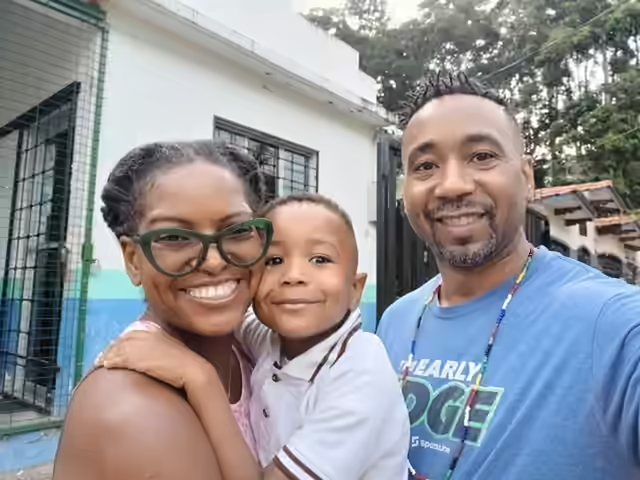
Earlier this week, my wife and I had one of our money dates.
We talked about our finances, the bills coming up, where we wanted to put our energy, and what each of us was working toward. Pretty normal stuff for a money date.
But somewhere along the way, we ended up talking about school uniforms, who was going to make lunch, picking Sage up from the bus, and what time we each needed to be available during the day.
We probably spent just as much time talking about those things as we did the actual money.
And the more we talked, the more it made sense.
Last week, I wrote about learning that not everything is mine to carry.
I had started noticing how much of my energy went toward things that weren’t necessarily my responsibility.
Sometimes that meant taking on something that belonged to someone else.
Other times, it meant holding on to an idea or project simply because I’d already invested time in it.
I’ve been continuing that work this week, and I think I’m getting to the part that requires a little more thought.
Once you start putting things down, you have to decide what you’re going to pick back up.
And for me, that’s meant taking a closer look at my responsibilities, both at home and in the things I’m building.
Making room in our marriage
One of the things we’ve been working through in our marriage is how to manage our capacity.
We’ve had plenty of conversations about needing more time, dividing responsibilities, and supporting each other in the things we’re trying to accomplish. But even when we agreed on what needed to happen, we didn’t always have the same understanding of who was going to make it happen.
That’s where things can get interesting.
We can both be working hard, both be contributing, and still end up frustrated because there’s a gap somewhere in the middle.
I’ve felt like the person responsible for making sure things get done around the house. My wife has felt a similar responsibility when it comes to our finances. And when we’re both operating near capacity, those gaps become a lot more noticeable.
During our money date, we spent time looking at what our days actually require.
There’s the morning routine, getting Sage ready for school, lunch, the afternoon pickup, dinner, baths, and bedtime. Then we have our individual work, the things we’re building, and the time we need to handle whatever else life decides to throw at us that day.
And somewhere in there, we’d also like to enjoy being married to each other.
We’ve tried keeping responsibilities flexible in the past. The idea sounds great because we can help each other when needed, and neither person has to be locked into doing the same thing every day.
The challenge we’ve had is that flexibility can sometimes leave us waiting on each other.
If neither person has clear ownership, it’s easy for a task to sit there until someone notices it needs to be done. Then we end up having another conversation about something we thought we’d already discussed.
Even something as simple as Sage’s school uniforms can become a point of frustration when we have different understandings of whose responsibility they are.
So this week, we decided to get more specific.
For the next seven days, my wife is taking ownership of lunch, Sage’s afternoon pickup, and school uniforms. I’m taking ownership of dinner, baths, and bedtime. We’ll continue sharing the morning responsibilities and then revisit how the arrangement is working after a week.
Nothing particularly complicated about that.
But what I appreciate about this arrangement is that we each know what we’ve agreed to handle, and we can plan the rest of our day around those commitments.
If dinner is mine, I need to account for that when I’m planning my afternoon. And if lunch belongs to my wife, I can give my attention to the work in front of me without constantly wondering whether I need to make room for it.
Of course, life will still happen. Someone will be tired, plans will change, and there will be days when one of us needs more support.
The hope is that having a clear starting point makes those adjustments easier.
I’m also learning that part of giving someone ownership is allowing them to handle it without me trying to manage every detail. That’s an area where I still have some work to do.
I can be pretty quick to notice what needs improving, even when something is already working. I’ve mentioned that before, and apparently knowing it’s a habit doesn’t automatically make the habit disappear.
But I want us both to experience the freedom that comes from being able to trust the agreements we’ve made.
We’re only a few days into this experiment, so we’ll see how it goes.
Looking at what I was carrying in my work
Interestingly, I’ve been having a very similar conversation with myself about my projects.
If you’ve been following along for a while, you know that I enjoy building software. I can come up with an idea, start putting it together, and get pretty excited about what’s possible.
The problem is that I don’t always stop at one idea.
Over the past several months, I’ve been working on multiple applications, along with client work, family projects, and other things I wanted to bring into the world.
Each project had its own roadmap, features I wanted to build, bugs to fix, and decisions waiting for me.
Even when I wasn’t actively working on something, it was still taking up space in my head.
I’ve spent a lot of time this week looking at that list and asking which of those projects really need my attention right now.
One of the more interesting discoveries came when I started comparing three of the applications I’d been working on.
FounderOS was something I created to help me manage my projects and keep track of what was happening across my work. It could generate reports, daily summaries, and planning materials. I even had it producing presentations to help me review everything.
And then I realized I wasn’t really using most of what it was giving me.
The reports were being created, the emails were arriving, and I had another thing I was supposed to keep up with.
I had built a system to help me manage my work, and in some ways, the system itself had become more work.
At the same time, I was building Roomfor, an application designed around capturing your thoughts and experiences, making sense of them, and helping you plan your days and weeks.
Then there was my Content System, which was growing into a place where I could bring in audio recordings, videos, written thoughts, and other material, understand what was there, and turn it into something useful.
As I looked at these projects together, I started noticing how much they had in common.
Roomfor was helping people capture and reflect on what’s happening in their lives. The Content System was doing a lot of that same work, with additional tools for turning those experiences into content.
And much of what I wanted from FounderOS could be supported by the same system.
I had been treating them as three separate applications because that’s how I originally started building them.
But I no longer needed three different products to accomplish what I was trying to do.
So I’ve been working toward bringing them together under Roomfor.
Roomfor will continue to focus on the personal experience of reflection and planning, while Roomfor Studio will support the more advanced work of capturing, organizing, and creating from what we’re already doing.
The parts of FounderOS that are still useful can become part of that experience instead of requiring another application for me to maintain.
I’m excited about this direction.
There are still plenty of decisions to make about how everything comes together, but the work feels much more focused now. And I can put more energy into improving one connected system instead of continually dividing my attention across several.
It’s funny how sometimes the work you’ve already done starts making more sense once you stop insisting that every idea needs to stand on its own.
The bigger picture is starting to make sense
There’s another project taking up a good amount of our attention this week, and it’s one I’m happy to make room for.
We’re working on a proposal connected to the Garifuna Family Tree project and a larger effort to preserve Garifuna history and heritage.
The work involves creating ways to document family connections and preserve the stories, knowledge, and experiences that can so easily be lost between generations.
We’ve been thinking about how technology can support that work, along with the funding and partnerships needed to help it grow.
I love the technical side of a project like this.
Building a system that can connect family histories, photographs, recordings, and the stories behind them is exactly the sort of thing that gets me excited about software.
But what makes this particular project meaningful is what the technology can help preserve.
There are stories that live with our parents and grandparents that we may never think to ask about until we no longer have the opportunity. Family history can become a collection of names and dates when there’s so much more that could be passed down.
And with communities like the Garifuna, where families have spread across different countries and generations, preserving those connections becomes especially important.
A family tree can help someone understand where they came from. But imagine being able to explore the stories behind the names, hear the voices of relatives, learn about the communities they lived in, and discover traditions that might otherwise be forgotten.
That’s the kind of experience we’re interested in supporting.
This week, we’re putting together materials to seek support for that larger vision. It’s been taking some focused work, and I’m glad we’re giving it the attention it deserves.
What’s been especially interesting is how this project has started influencing the way I’m thinking about Roomfor.
As we’ve been combining Roomfor and the Content System, I’ve been thinking more about what we’re actually creating.
At the personal level, Roomfor is about helping someone capture their experiences, understand what’s happening in their life, and make room for the things they want to experience.
Roomfor Studio takes much of that same information and gives people tools to work with it. You can bring in recordings, videos, writing, and other material, then use that information to create something useful, whether it’s a personal reflection, a newsletter, or another creative project.
Now consider the Family Tree.
Many of the things we’re trying to preserve are also stories, experiences, and memories. They may come from interviews with elders, family photographs, historical records, or conversations that someone thought to record.
The information is different, and the responsibility that comes with handling it is different, especially when it belongs to families and communities. But I can see how much of the underlying technology we’re building could support that work.
An application designed to help someone preserve and understand their personal experiences could also provide some of the tools needed to preserve family and community history.
That connection has opened up another possibility I’ve been exploring.
I’ve started thinking about a community-focused effort under the working name Roomfor Foundation.
The idea is to make some of the tools and infrastructure we’re creating available for projects that serve a larger community benefit, beginning with work like the Garifuna Family Tree.
Some of that could involve making software available for others to build upon. Other parts could involve partnerships with communities and organizations that want to preserve their own history.
It’s still early, and we’re working through what that would look like. The Garifuna project has its own mission and needs, and we’re focused on moving that work forward.
But I’ve started to see how the things I’m building commercially could support the work I want to do in communities, and how the needs we discover through that community work could help us build better tools.
We’re making some changes to the Roomfor website to reflect this direction.
Rather than presenting Roomfor as one application with a growing list of features, I want the site to show the different ways we’re thinking about making room for the things that matter.
There’s room for the individual who wants to be more intentional about their life.
There’s room for someone who wants to capture their experiences and share their ideas.
And there’s room for families and communities who want to preserve something meaningful for future generations.
I’ve also been thinking about how this fits into the larger picture of my own work and what I’m sharing here.
For a long time, I’ve had different projects that seemed to belong in different categories.
Software, relationships, personal development, family history, entrepreneurship.
Depending on which one I was talking about, you might have gotten a very different impression of what I actually do.
But these things have never felt completely separate to me.
I’ve always been interested in understanding how we can live better lives, build things that give us more freedom, and use what we know to help other people do the same.
I’m starting to see that connection more clearly in the work itself.
And now that I can see it, I don’t feel the same need to carry every piece as its own separate undertaking.
What I’m choosing for now
One of the realities of this season is that I need to be especially thoughtful about how I’m spending my time.
I’m also a husband and a father, and the responsibilities that come with those roles don’t disappear when I have a deadline or something exciting I want to build.
There are only so many hours in a day, regardless of how many ideas I have.
I think part of what made my project list so overwhelming was that I kept treating everything I wanted to do as something I needed to be doing right now.
And when everything has a place on the active list, even the things that matter most can struggle to get enough attention.
So I’ve been narrowing things down.
I’m starting to appreciate how much easier it is to give something my attention when I’m no longer trying to give everything my attention.
There was a time when having all these projects going felt exciting, and in many ways it still is. I love knowing that I can take an idea and build something from it.
But I’ve also learned that just because I can build something doesn’t mean I need to build it right now.
And when I look at what’s happening with Roomfor, I can see that reducing the number of projects I’m managing hasn’t reduced the possibilities of what I might create.
In some ways, it’s made those possibilities easier to see.
For now, it feels good to have a clearer understanding of what I’m choosing to carry.
Last week’s letter was about the things I needed to put down.
This week has been about looking at what’s left and making some decisions.
I still have plenty on my plate. I’ll be making dinner, handling bedtime, project pitches, and probably thinking of a few more software ideas that I have no business starting right now.
Some habits take longer to change than others.
But I’m getting better at letting an idea be an idea without immediately turning it into another commitment.
And I’m interested to see what happens when the things I’ve chosen finally have enough room to grow.
A few things from my week
📖 What I’m reading: Out of This World by Neville Goddard
I’ve been spending some extra time with Neville Goddard’s Out of This World this week.
This is one of those books I come back to constantly. I probably read or listen to it at least once a week, and somehow I continue to find something new in it.
Neville talks about imagination as the source of the things we experience in the physical world. Everything we create, in some sense, existed in imagination before we experienced it.
I’ve practiced his methods for years, and there are quite a few things in my life today that I believe came about through that practice.
What I’ve been spending more time with lately is imagining the future I want to experience and allowing myself to feel what it would be like to already be living it.
I think that’s especially useful during a season like this one, where there are so many practical things demanding my attention.
It’s easy to get consumed with how everything is going to happen. How the money is going to come in, how the projects are going to move forward, how we’ll make everything fit into the time we have.
And while those things deserve attention, I’ve been reminding myself to spend time with the experience I actually want to create.
What does my life look like when I’m doing meaningful work, providing for my family, spending time with the people I love, and enjoying what we’ve built?
That’s the picture I’ve been spending more time with this week.
📺 What I’m watching: The Traitors
We’re still watching The Traitors.
And now Sage has gotten into it too.
He’s been watching with us and has started asking about it, which I find pretty funny. Apparently, a show built around people trying to figure out who’s lying has become part of our family entertainment.
I love that we have another little thing we’re enjoying together.
No major life lesson from this one. We’re just enjoying the show.
🎵 What I’m listening to: Ha by Juvenile
This might be one of my favorite connections I’ve made lately.
I’ve been listening to Juvenile’s Ha, and there’s a line in the chorus about handling your business without crying and suffering.
I’ve heard this song more times than I could count over the years, but lately that part has been hitting a little differently.
There’s also a prayer I’ve been spending time with that talks about murmuring, or complaining about our circumstances.
And I started thinking about the connection between the two.
I’ve heard people say that suffering is a choice, and I’ve spent time thinking about what that actually means.
Because when you’re going through something difficult, it doesn’t always feel like a choice. There are things happening in life that are genuinely hard, and I don’t think pretending otherwise serves anyone.
But I’ve been paying more attention to the way I respond to those things, especially the conversations I’m having with myself.
I can acknowledge that something is difficult without spending the whole day complaining about it. I can have responsibilities that feel heavy and still choose how I approach them.
That’s where the prayer and Juvenile have been meeting for me lately.
And because I apparently needed a more direct reminder, I’ve started using Ha as my morning alarm.
Yes, Juvenile is waking me up in the morning.
There’s something about starting the day with that energy, being reminded to handle my business, and getting out of bed ready to do what needs to be done.
It’s been a good reminder during a week where I’ve been making decisions about the responsibilities I’m choosing to carry.
I may not get to decide everything that shows up in my day, but I do have some say in what kind of energy I bring to it.
And if Juvenile helps me remember that at six in the morning, I’ll take it.
That’s what I’ve been working through this week. If any of it connects with something you’re experiencing, I’d love to hear about it.
Talk soon,
-JP
A couple of ways we can work together
1:1 Clarity Session
Have a decision, idea, project, or something in your life you’ve been carrying around longer than you need to?
We can spend an hour looking at it together, asking better questions, and getting clear on what comes next.
Roomfor + Roomfor Studio
I’m building Roomfor to help us capture our thoughts, reflect on our experiences, and make better use of what we’re already doing.
Roomfor focuses on personal reflection and planning, while Roomfor Studio is growing into a creative workspace for turning everyday experiences, recordings, and ideas into useful content.
We’re also exploring how the same tools can support community projects like the Garifuna Family Tree, helping preserve stories and family history for future generations.
Know someone who might enjoy this letter?
Feel free to forward it to a friend, share a thought from it, or pass it along however you find helpful.
And if someone forwarded this to you, you can subscribe to my weekly letter here.
Thanks for reading.